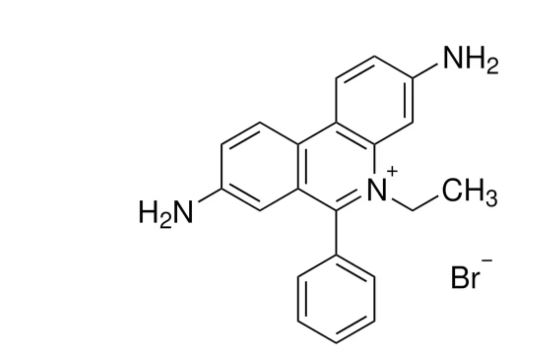
Description
Synonyms: 3,8-Diamino-5-ethyl-6-phenylphenanthridinium bromide, EtBr, Homidium bromide
Application
Ethidium bromide (EtBr) is the most commonly used nucleic acid stain for PAGE or agarose gel electrophoresis. The fluorescence of EtBr increases 21-fold upon binding to double-stranded RNA and 25-fold on binding double-stranded DNA so that destaining the background is not necessary with a low stain concentration (10 μg/ml). Ethidium bromide has been used in a number of fluorimetric assays for nucleic acids. It has been shown to bind to single-stranded DNA (although not as strongly) and triple-stranded DNA. Because of its ability to bind to DNA, EtBr is an inhibitor of DNA polymerase.
Frameshift mutagen which intercalates double-stranded DNA and RNA.
Biochem/physiol Actions
Ethidium bromide intercalates double-stranded DNA and RNA and acts as a frameshift mutagen. It can also be used in conjunction with acridine orange to differentiate between viable, apoptotic and necrotic cells.
Reconstitution
For staining a gel after electrophoresis, dilute a sample of the stock solution to 0.5 μg/ml with water and incubate the gel for 15-30 min. Destaining is usually not needed but can be carried out in water for 15 min if decreased background is necessary. The DNA bands can then be detected on a UV light box (254 nm wavelength). Ethidium bromide can also be incorporated into the gel and running buffer at 0.5 μg/ml and visualized immediately after electrophoresis.
PROPERTIES
grade
for molecular biology
Pack Size
1g
product line
BioReagent
form
powder
technique(s)
electrophoresis: suitable
mp
260-262 °C (dec.) (lit.)
fluorescence
λex 360 nm; λem 590 nm in PBS
λex 526 nm; λem 605 nm (10 mM TBE; pH 8.0;)
λex 526 nm; λem 605 nm in aqueous buffer



Reviews
There are no reviews yet.