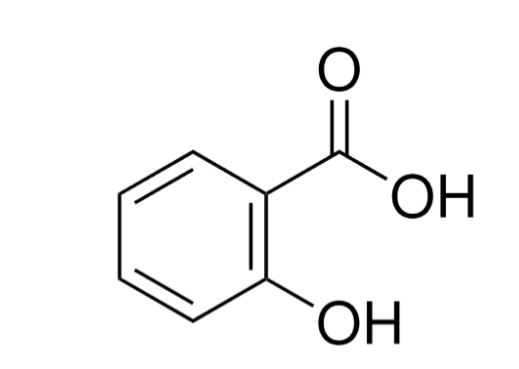
Description
Synonym: 2-Hydroxybenzoic acid
Linear Formula: 2–(HO)C6H4CO2H
Molecular Weight: 138.12
Assay: ≥99.0%
DESCRIPTION
Salicylic acid is mainly used as the precursor to synthesize aspirin, a commonly used analgesic and antipyretic. Due to its keratolytic action, it is also used in topical ointments.
Application
Salicylic acid has been used:
- as one of the chemical compound in exposure-based validation of in vitro gastrulation model employed in developmental toxicity screening assays
- as a reference standard in salicylate quantification by reverse-phase high-performance liquid chromatography (RP-HPLC)
Biochem/physiol Actions
Salicylic acid (SA) delivers local and systemic acquired resistance (LAR and SAR) against various diseases in plants. It acts as a secondary metabolite and regulate various physiological processes such as respiration, stomatal closure and senescence-associated gene expression. In addition, SA also controls abiotic stress, basal thermotolerance, nodulation in legumes and fruit yield. It plays a vital role in modulation of flowering and thermogenesis (heat production) in plants. SA together with reactive oxygen species (ROS) and nitric oxide (NO) triggers cell death in plants.
PROPERTIES
grade
ACS reagent
Pack Size
500g
vapor density
4.8 (vs air)
vapor pressure
1 mmHg ( 114 °C)
assay
≥99.0%
impurities
H2SO4, passes test (darkened)
ign. residue
≤0.01%
bp
211 °C (lit.)
mp
158-161 °C (lit.)
anion traces
chloride (Cl–): ≤0.001%, sulfate (SO42-): ≤0.003%
cation traces
Fe: ≤2 ppm, heavy metals (as Pb): ≤5 ppm
functional group
carboxylic acid


Reviews
There are no reviews yet.