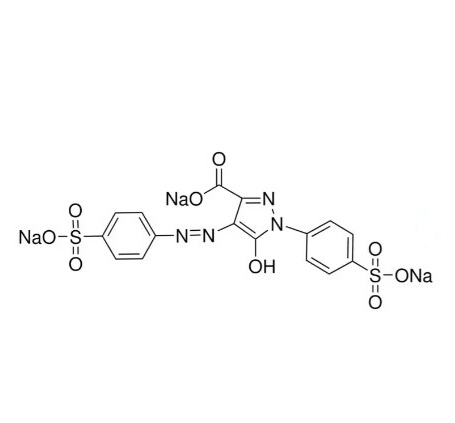
Description
Synonym: Acid Yellow 23
Empirical Formula (Hill Notation): C16H9N4Na3O9S2
Molecular Weight: 534.36
General description
Tartrazine (Cl 19140) also known as Acid yellow 23, is a hydrophilic polyanionic dye. It is a sulfonic dye, which can be synthesized by the reaction of sulfanilic acid with 3-carboxy-l-(4-sulfophenyl)-5-pyrazolone.
Application
Tartrazine may be used as a reference standard in the determination of tartrazine in food samples using ion-pair liquid chromatography coupled with photodiode-array and electrospray mass spectrometry detector.
The application of Tartrazine is seen in the phloxine-tartrazine procedure for cellular inclusions such as viral aggregates and eosinophil granules. It may be used as a substitute for orange G in a variant of Mallory′s trichrome, and in a methyl violet-tartrazine mixture to stain cryptosporidia in faecal smears and mucosal scrapings.
The application of Tartrazine is seen in the phloxine-tartrazine procedure for cellular inclusions such as viral aggregates and eosinophil granules. It may be used as a substitute for orange G in a variant of Mallory′s trichrome, and in a methyl violet-tartrazine mixture to stain cryptosporidia in faecal smears and mucosal scrapings.
Properties
Product Name
Tartrazine, Dye content ≥85 %
form
powder
Pack Size
100g
composition
Dye content, ≥85%
technique(s)
titration: suitable
color
orange
solubility
H2O: 10 mg/mL, clear, yellow to orange
density
2.12 at 20 °C
εmax
435-500 at 425-429 nm in water
application(s)
diagnostic assay manufacturing
hematology
histology
storage temp.
room temp



Reviews
There are no reviews yet.