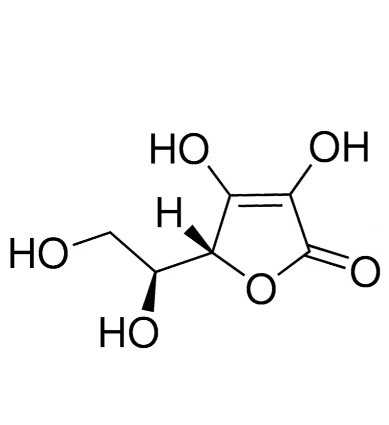
Description
reagent grade, crystalline
Synonyms: Antiscorbutic factor, Vitamin C, L-Threoascorbic acid
Empirical Formula (Hill Notation): C6H8O6
Molecular Weight: 176.12
General description
L-Ascorbic acid biosynthetic pathway varies in plants, animals and fungi. It is synthesized from L-gulono-1,4-lactone by the action of enzyme L-gulono-1,4-lactone oxidase (GLO).
Application
L-Ascorbic acid has been used:
- as a chondrogenic medium component for culturing bone-derived mesenchymal stem cells (BMSCs)(149)
- as a reference standard in high-performance liquid chromatography system (HPLC)(150)
- to test its effect on human gastric cancer GES-1 and AGS cells(151)
Biochem/physiol Actions
Ascorbic Acid, also known as Vitamin C, is a six-carbon lactone produced by plants and some animal species but not by humans and other primates. Ascorbic acid functions as an enzymatic cofactor for multiple enzymes, serving as an electron donor for monooxygenases and dioxygenases. Ascorbic acid also functions as a powerful antioxidant, particularly in regards to reactive oxygen species.
L-Ascorbic acid deficiency is associated with lack of L-gulono-1,4-lactone oxidase (GLO) enzyme. It elicits antioxidant functionality and gets oxidized to dehydroascorbate via ascorbyl radical intermediate. L-Ascorbic acid is essential for maintaining the redox balance. It is a cofactor for dopamine-β-hydroxylase and favors T cell proliferation, protects immune system and provides relief in common cold.
Properties
biological source
synthetic
Pack Sizes
1kg; 5kg
grade
reagent grade
assay
≥98% ( with iodine, titration)
form
crystalline
technique(s)
HPLC: suitable, cell culture | stem cell: suitable
color
white to slightly yellow
pH
1.0-2.5 (25 °C, 176 g/L in water)
mp
190-194 °C (dec.)
solubility
water: soluble 50 mg/mL
storage temp.
room temp


Reviews
There are no reviews yet.